

Tattooing
What happens to the skin when you get a tattoo?
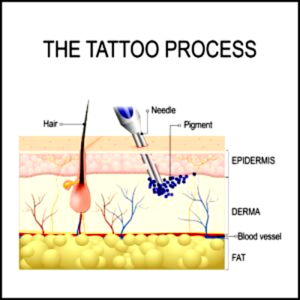
Tattooing is the process of depositing tattoo ink into the deeper layer of the skin, the dermis, using rapidly moving needles. This applies to both decorative tattoos and permanent makeup, which are based on the same biological principles.
Tattoo ink is a liquid mixture that is injected into the skin. It contains tattoo pigments, which are small, solid and insoluble particles that give the tattoo its colour. The liquid carrier is gradually broken down and removed by the body, while the insoluble pigment particles remain in the skin. These solid particles are what make a tattoo permanent.
Why does a tattoo remain in the skin?
When pigment particles are deposited in the skin, the body immediately recognises them as foreign material. This activates the immune system.
Special immune cells called macrophages move towards the affected area. Their role is to clear away foreign substances. They surround the tattoo pigment particles and store them inside the cell.
For many years, it was believed that tattoos remain in place because the cells containing the pigment stay in the skin forever. However, research has shown that this is not the whole story.
Macrophages do not live forever. When a macrophage containing pigment eventually dies, it releases the pigment particles back into the surrounding tissue. New macrophages then take up the pigment again. This continuous cycle of uptake, release and renewed uptake largely explains why tattoos can remain stable for decades, even though the individual immune cells are constantly being replaced.
.
Tattoos are a popular form of body decoration and have become increasingly common over the past few decades. We are also seeing a growing number of other applications of tattooing, such as permanent makeup and medical tattoos.
A tattoo is a unique form of body art, and the reasons for getting one vary widely. A tattoo may be chosen purely for its aesthetic appeal, but it may also symbolise an experience, an achievement, a loss or the closing of a chapter in someone’s life. The positive and emotional value of a tattoo differs from person to person and may be deeply important to some individuals.
In some cases, tattoos also serve a medical purpose. Examples include tattoos used as markers for radiotherapy, tattoos used to camouflage skin or hair conditions, and nipple and areola tattoos following breast reconstruction after breast cancer.