

Alternative Tattoo Removal
Laser treatment is currently considered the most effective and best studied method for tattoo removal. However, many alternative methods are marketed as cheaper, faster or more “natural” options. These include surgical removal, dermabrasion, salabrasion, cryotherapy, radiofrequency and chemical products such as tattoo removal creams or injected solutions.
Although these methods may sound appealing, most do not selectively remove tattoo ink. Instead, they damage or destroy the skin in order to remove pigment. This increases the risk of scarring and long term skin changes
Chemical tattoo removal creams
How do these products claim to work?
Alternative tattoo removal creams and injectable solutions usually claim that they “draw the ink out of the skin” or “lift pigment to the surface.” In reality, most of these products work by creating a uncontrolled chemical burn in the skin.
The chemical injury causes inflammation, crust formation and sometimes tissue necrosis. When the crust falls off, some pigment may be removed along with damaged skin. However, this process does not specifically target tattoo ink. It destroys healthy skin tissue together with the pigment
Some products are injected into the tattooed skin using tattoo equipment. Small circular wounds are created, which can become necrotic before healing
Common ingredients
Reported ingredients in non laser tattoo removal products include:
- Lactic acid, sometimes in high concentrations
• Trichloroacetic acid
• Phenol
• Silver nitrate
• Nitric acid
• Sulphuric acid
• Salicylic acid
Some commercial injection products have contained around 40 percent lactic acid, while others include combinations of metal oxides and alkaline substances.
Importantly, ingredient lists are often incomplete or not transparently available to consumers.
What can go wrong?
Scientific reports describe significant complications after removal with caustic products.
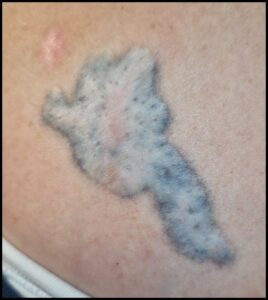
Reported complications include:
- Hypertrophic scars and keloids
- Chemical burns
- Deep dermal wounds
- Hypopigmentation or hyperpigmentation
- Chronic pain or altered skin sensation
- Incomplete removal with remaining pigment
- Need for corrective laser or surgical procedures
Other Non Laser Methods
Other non laser techniques include:
Surgical excision, where the tattooed skin is cut out and the wound is closed with stitches. This always leaves a scar and is only suitable for small tattoos
Dermabrasion or salabrasion, where the top layers of skin are mechanically scraped away. These techniques may remove pigment but are associated with scarring and pigment changes
Cryotherapy and radiofrequency, which destroy tissue using extreme cold or heat. These methods can cause blistering, scarring and unpredictable cosmetic results
Why laser remains the standard
Laser removal works differently. It specifically targets tattoo pigment particles with short pulses of light energy, breaking them into smaller fragments that can be cleared by the body. While laser treatment also carries risks and may require multiple sessions, it does not intentionally create chemical burns in the skin. Complications after tattoo removal are also seen in dermatology clinics and can include scarring, dyspigmentation and other skin changes. For more information, see our page on laser tattoo removal.
Sources
Hutton Carlsen K, Serup J. Sequels to tattoo removal by caustic products. Skin Research and Technology. 2018.
van der Bent SAS et al. Complications of tattoos and permanent makeup: overview and analysis of 308 cases. Journal of Cosmetic Dermatology. 2021.
Dash G et al. Non laser treatment for tattoo removal. Journal of Cosmetic Dermatology. 2022.
Views: 0