

Laser
What is the best way to remove a tattoo?
Laser treatment is the most targeted and safest method for tattoo removal. This specifically refers to Q-switched lasers, such as nanosecond and picosecond lasers (PICO lasers).
There are many other types of lasers, such as vascular lasers and CO₂ lasers; however, these are used for different indications and purposes and are not intended for tattoo removal.
How does laser treatment work for tattoos?
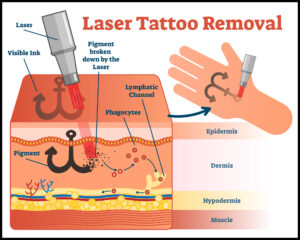
A laser beam, consisting of light with a specific wavelength, is directed into the skin. The ink pigment is selectively targeted and rapidly heated within a very short time (i.e. the pulse duration), causing it to break apart into smaller fragments. These pigment particles are subsequently removed by the body, causing the tattoo to gradually fade.
How many laser treatments are needed?
On average, 8 to 13 treatments are required. However, the exact number strongly depends on several factors. Complete removal is also not possible in every individual.
The most important factors are:
● Client skin type
The darker the skin, the more difficult tattoo removal becomes.
● Location of the tattoo
Tattoos on the face are easier to remove. Tattoos on the hands and feet are significantly more difficult.
● Amount of ink and number of layers
A tattoo with a high amount of ink, possibly with multiple layers such as a cover-up tattoo, is more difficult to remove.
● Tattoo color
Black is the easiest color to remove. Red and purple are more challenging. Green and light blue are difficult to remove. Yellow and white are very difficult to remove, as these pigments absorb little or no laser light.
A rough estimate of the number of treatments can be made using scoring systems such as the Kirby–Desai scoring system or the Smarrito–Pineau model.
Are there side effects or complications?
It is important that the correct laser and appropriate handpiece are used. In addition, the treatment should be performed by a skilled and well-trained practitioner.
Even when treatment is performed correctly according to recommended settings, complications may still occur, such as:
● Blistering
● Bruising
● Pigment changes such as lighter skin (hypopigmentation) or darker skin (hyperpigmentation). The risk increases as skin tone becomes darker.
● Scarring (rare)
● Allergic reactions (rare)
● Paradoxical darkening, sometimes referred to as the “confetti effect”
In paradoxical darkening, a different, often darker, color appears after laser treatment. This is essentially the opposite of the intended result. Paradoxical darkening is more commonly seen in permanent make-up and in shaded areas of regular tattoos. This occurs because these inks more often contain iron or titanium oxides, which are responsible for this effect.
What about laser treatment and cancer?
There is no scientific evidence that laser tattoo removal causes cancer. Laboratory studies sometimes identify breakdown products that could theoretically be harmful, but in clinical practice no increased incidence of skin cancer or other cancers has ever been observed following laser treatment.
Large international expert groups, including European dermatological and laser societies, conclude that the treatment is safe. Continued research in this area is recommended.
Note
The CO₂ laser is not a standard laser used for tattoo removal. However, it may be used in cases of tattoo-related allergic reactions.
Medical disclaimer
The medical information on this page has been independently prepared by Tattooandhealth.com. The content provides general education about tattoo-related skin reactions and is independent of clinical care provided in hospitals or private clinics.