

Complications
In the majority of cases, getting a tattoo proceeds without any problems. However, there are certain risks that should be taken into account. In a small proportion of tattoos, abnormalities or skin complaints may occur, including itching, lumps, pain, swelling of the tattoo, or wounds.
Establishing the correct diagnosis of the underlying skin condition is important for appropriate treatment. Examples of skin conditions include allergies, infections, scar formation, and autoimmune skin diseases such as psoriasis, sarcoidosis, and lichen planus.
Note: Follow us on Instagram for the latest updates.
Tattoo allergy
In some cases, allergic reactions to tattoo ink may occur. This is an exaggerated response of the immune system to the dye (pigment) or another component of the tattoo ink. These reactions may present with one or more of the following symptoms: swelling or elevation of the tattoo, itching, small bumps, scaling, skin nodules, or (very rarely) open wounds or blisters.
Allergic reactions can occur with all ink colors, but most commonly with red ink. Symptoms may develop weeks or even years after the tattoo has been placed. At present, it is not possible to predict when—or if—someone will develop an allergic reaction to tattoo ink. Each person has a unique immune system, and skin responses vary from individual to individual. Therefore, tattoo artists are also unable to predict these reactions.
In addition, allergic reactions are not limited to tattoo ink alone. Allergies may also occur in response to the tattoo artist’s (latex) gloves or to tattoo aftercare products.

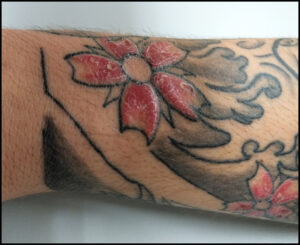
Allergic reaction to red tattoo ink
Treatment
Treatment can be challenging, and a satisfactory solution cannot always be achieved. Nevertheless, several treatment options are available, including topical ointments or creams, injections, or specific laser treatments.
Autoimmune skin diseases
Autoimmune diseases are disorders of the immune system. Under normal circumstances, the immune system protects the body against infections such as bacteria and viruses. In autoimmune diseases, the immune system does not function properly and also attacks the body’s own healthy cells.
There are many autoimmune diseases that can affect the skin, including psoriasis, lichen planus, sarcoidosis, vitiligo, lupus erythematosus, lichen sclerosus, and others. Sarcoidosis, for example, may initially present as swelling of a tattoo (see photo). However, a swollen black tattoo does not necessarily mean that sarcoidosis is the underlying cause.


Swollen black tattoo
It is well known that autoimmune skin diseases can manifest specifically within a tattoo. This is thought to be caused by the tattooing process itself, as it may lead to a local flare-up of the condition. This triggering effect is known as the Koebner phenomenon.
The stimulus of tattooing activates the immune system, causing the autoimmune disease to appear at that specific site. Not only tattooing can cause this trigger; other forms of skin trauma, such as a fall or surgery, may also activate the immune system.
In some cases, skin changes within a tattoo may be the first sign of an underlying autoimmune disease. Timely and accurate diagnosis of these conditions is therefore essential.


Psoriasis vulgaris in a recently applied tattoo
Treatment
In general, therapy consists of specific topical ointments containing corticosteroids. In some autoimmune diseases, organs other than the skin may also be involved, such as in sarcoidosis or lupus erythematosus. There is also a specific condition in which swelling of black tattoos occurs together with eye symptoms: tattoo-associated uveitis.
In these cases, treatment may include oral medication, such as Plaquenil (hydroxychloroquine), methotrexate, or (temporarily) prednisone.
Infections
Despite established hygiene guidelines, infections remain the most common complications associated with tattoos. These are mainly caused by bacteria or viruses that enter the skin during or shortly after the tattooing process. This may occur due to insufficiently disinfected skin or needles, contaminated tattoo ink, or inadequate hygiene during tattoo aftercare by the client. In many cases, the exact source of contamination cannot be identified.
Early recognition of an infection is important in order to prevent further damage.
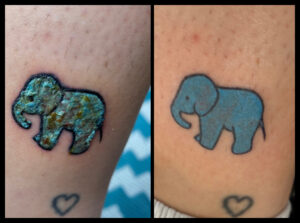
Bacterial infection in a tattoo
Treatment
In general, therapy consists of specific topical ointments containing corticosteroids. In some autoimmune diseases, organs other than the skin may also be involved, such as in sarcoidosis or lupus erythematosus. There is also a specific condition in which swelling of black tattoos occurs together with eye symptoms: tattoo-associated uveitis.
In these cases, treatment may include oral medication, such as Plaquenil (hydroxychloroquine), methotrexate, or (temporarily) prednisone.
Infections
Despite established hygiene guidelines, infections remain the most common complications associated with tattoos. These are mainly caused by bacteria or viruses that enter the skin during or shortly after the tattooing process. This may occur due to insufficiently disinfected skin or needles, contaminated tattoo ink, or inadequate hygiene during tattoo aftercare by the client. In many cases, the exact source of contamination cannot be identified.
Early recognition of an infection is important in order to prevent further damage.
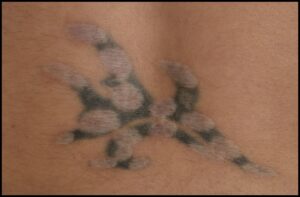
Scarring and pigment disorders following the use of alternative tattoo removal products
Other skin reactions
There are numerous other complications that may develop in the skin as a result of tattooing. Examples include scarring, keloids, blow-out, and pigment displacement or discoloration.
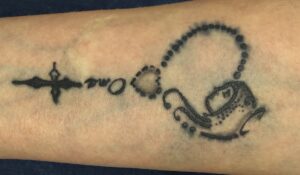
 Blow-out by black tattoo
Another, largely still unknown complication is neurosensory pain or itch within a tattoo. This is a poorly understood condition characterized by severe neurogenic itching or pain, occurring precisely at the site of the tattoo. The tattoo appears normal, and no visible abnormalities are present.
The cause and underlying mechanism of this condition are currently unknown.